





Teaching music beyond sight-reading and performance
On January 15, 2025, I gave a webinar for music educators and parents of music students about teaching real-world music skills to young piano students. Many of these music skills, ones that practicing musicians use most, tend to be ignored in traditional, sight-reading-based piano teaching methods. If students are introduced to these skills early in their piano studies, and are guided step-by-step as they continue to develop them, they’ll be ready for a lifetime of confident music making.
Introducing the Hoffman Method
When I began teaching piano 20 years ago, I taught the way I was taught. I chose a traditional piano method that used a series of books intended to help students learn to sight read and perform practiced songs. But, as I thought about my friends who were studying jazz piano in college, I was blown away by their ability to sit down and play by ear, improvise, compose, and transpose, things that I had never learned to do. I also knew that most of the great classical musicians we esteem like Bach and Beethoven were improvisers. They were creators. They would sit down at the keyboard and invent new music in the moment. I realized that traditional methods of teaching piano were missing a big chunk of music education. I wanted to fix that. I wanted my young students to do so much more than I had been taught to do. I wanted them to be able to play by ear and by sight, to both perform memorized repertoire and to be able to improvise something new on the spot. I wanted them to have it all. That’s why I developed the Hoffman Method.
What’s our main objective in teaching music
Let’s think about how our students will actually be using their piano skills in 30 years.
How many of them will be professional concert pianists, who study technically brilliant piano pieces and then perform them? Very, very few. But most traditional methods for teaching piano seem to treat this kind of piano playing as the primary end goal.
Instead, consider how the young piano students of today will most likely use their music skills in their lifetime. Some will play the piano at church. Others will play, compose, or arrange for a rock or jazz band. They might accompany a choir, a vocalist, or an instrumentalist. They could gig for weddings, parties, or other events. Most will have a time when they’d love to be able to play something by ear. Even something as simple as making up silly songs for their kids at bedtime or sitting down to enjoy playing a piece they like. These are the musical gifts we want to give our students for their future.
When we align our music teaching with these long term goals, we’ll shift our curriculum to include skills like transposing, dictation, chord symbols, improvising, lead sheets, harmonic analysis, composing, and arranging. We’ll want to help our students become confident in their own music skills, knowledgeable in music theory, curious, creative, and willing to explore and take risks.
Techniques for teaching music
So, how do we get there? There are some basic, foundational skills that can be taught from the very beginning that will help our students develop the qualities they need to be confident musicians for life. Here are a few of my favorites:
Pentascales
A pentascale is the first five notes of a major or minor musical scale. Most piano teaching methods spend little or no time on pentascales and start instead with the one octave scales, but there are so many things that can be learned from pentascales alone. Pentascales are easy to play because they don’t require fingers to cross over and under. This allows students to focus on and internalize the pattern of whole steps and half steps that make the difference between major and minor. Once a student knows their pentascales, they automatically know all of their triads. Pentascales are also a great way to introduce transposing.
Watch this clip from my webinar for more details about how to use pentascales in your music teaching:
Improvisation
Improvisation can seem intimidating, but, even if you’ve never tried it, I encourage you to start today! Improvising requires some music theory, but not a lot. All you need is a few chord progressions, a few accompaniment patterns, and a sense of playfulness. I like to think of improvisation as doodling. It’s spontaneous, like finding a wildflower while on a walk in the woods. An improvised piece of music is something of beauty or interest that happens once. Maybe a note you play sounds awful, but that’s no problem. Go on to the next note. Music has moments of tension and release. A note that sounds “bad’ is part of the music. Embrace it. Step through it and resolve the tension.
Improvisation can also seem overwhelming. When facing an entire keyboard of 88 keys, how do you know which ones to play? Solve this by starting simple. Choose a pentascale. Now there are only five notes. Not so bad. If five notes are still too many, choose just two notes.
As a teacher, you can ask your student to listen as you improvise a short, simple phrase of 2-4 notes, and then have them try to echo it. Now have them play something and you echo. This conversational back and forth is a foundational part of improvisation, especially in jazz music.
Improvisation sounds best with some accompaniment. As a parent or teacher, learn some simple chord progressions that you can play while your student plays a melody. Then switch places and have the student play the chords while you play a melody. Alternating between the I and IV chord is a good simple accompaniment in a major key, while a fun minor chord progression is i-VII.
Hoffman Academy Premium includes backing tracks for students to both practice songs they’ve learned and to improvise. This encourages students to improvise as part of their daily music practice. It’s also great to improvise live as well. A backing track will never respond to you, but when you play an improvised duet with another person there can be give and take. The heart of jazz improv is dialogue between the players.
So take time to improvise! Take risks, have fun, and cultivate a healthy attitude toward exploration and mistakes.
Triads and Chord Symbols
As I mentioned before, once a student knows their pentascales they will already know their triads. Simply leave out finger 2 and finger 4, and the remaining three notes form the triad. And, once a student knows their triads, they’re ready to read basic chord symbols, which will open up so many possibilities.
In most traditional, sight reading piano methods, all of the notes are written on the page for both the melody and the accompaniment. But, out in the real world, a lot of music is written with only a melody and chord symbols. These kinds of scores are called lead sheets, and many folk, pop, rock, and jazz bands use them to rehearse and perform.
Taking the time to learn to play music from a lead sheet will make it possible for a music student to play so many more of their favorite songs because they’ll be creating their own accompaniment at their level. Sometimes a student brings me a piece that they want to learn, but the piece is well beyond what they’ve ever played before. When that happens, I look to see if there are chord symbols written on the music. If so, then I can tell the student to learn the right hand part while simply playing chords in the left hand.
How to start teaching music
If you want to start teaching music as a private music teacher, there are a few steps you should take to prepare:
First, choose your piano method. There are many different piano methods available, so take some time to research and find ones that interest you. Talk to other piano teachers and find out what methods they like to use. Decide on a method that fits with your teaching style and priorities.
Second, prepare your teaching studio. You’ll need at least one piano, and you may want to add a second piano or electric piano for easy demonstrations or playing duets. Collect teaching aids, games, reference material, sheet music, and any other resources you may want to use. Read our article What Every Piano Teacher Needs in Their Studio for more ideas.
Third, decide what your policies are. You’ll need to determine how much you’re going to charge, how and when you will collect payment, and what you’ll do if a student misses or you need to reschedule a lesson. Make sure to put everything in writing and share it with your students and their parents so that everyone has clear expectations from the beginning.
Finally, let people know that you’re open for business! Start by talking to family and friends. Creating a simple website and sharing it with friends on social media can also be a good way to get the word out. You can also network with other music teachers by joining a professional music teachers association, such as your state chapter of MTNA.
If you’re interested in teaching piano with the Hoffman Method, our website has information and resources to guide you in getting started:
Our Teaching Piano page includes an introductory video and an overview of the Hoffman Method, along with a link to create a Teacher Studio account.
Watch our series of teacher training videos to learn more about the Hoffman Method and how to use it in your music teaching.
To learn more about teaching music at a school or university, read How to Become a Music Teacher.
Hoffman Academy Premium for teaching music
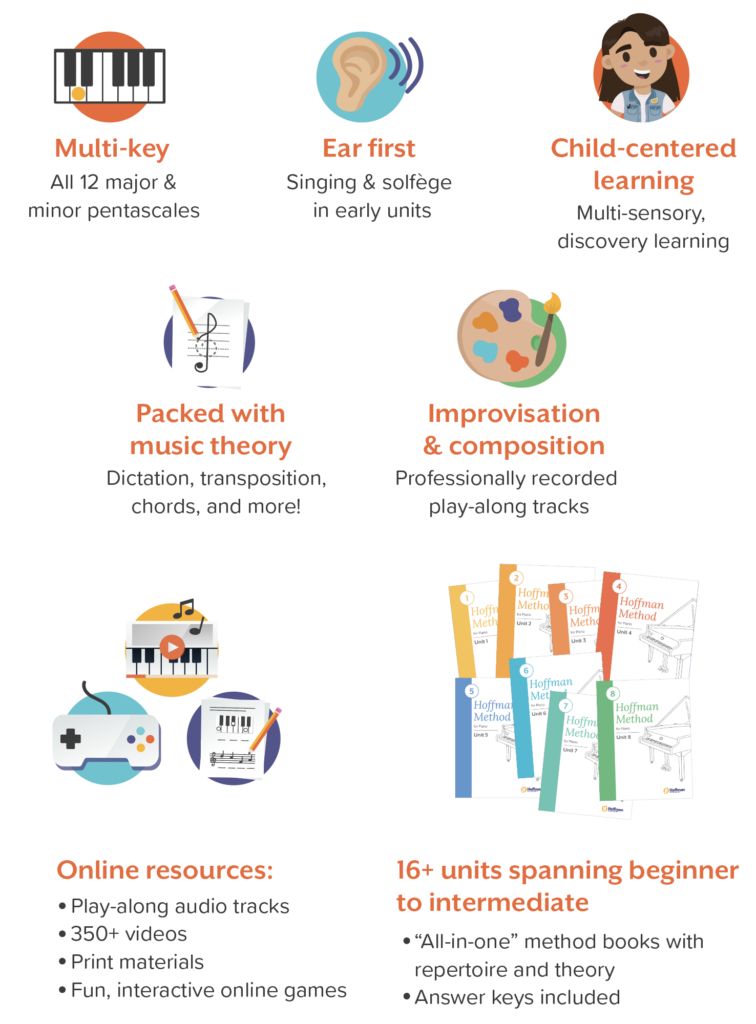
By creating a Teacher Studio account, you can grant Hoffman Academy Premium access to your students at a significant discount over our regular individual rates. Hoffman Academy Premium offers:
- 300+ piano video tutorials
- Listening tracks
- Play-along backing tracks
- Fun online music theory games
- Daily practice tasks
- Individualized progress tracking
- An extensive library of printable sheet music
- Reference guides for scales, rhythms, dynamics, piano posture, and more
- Printable music theory worksheets
- Printable flashcards, crafts, and board games
All of these features come in an easy-to-use web-based application students can access from their computer, tablet, or phone–anywhere, any time. You’ll also be able to view student progress and make assignments through your teacher dashboard, keeping your students engaged between lessons. To learn more about our online piano app, check out our article Our Free Piano App For Kids Makes Learning Fun.
The Hoffman Method for a complete music education
I created the Hoffman Method to teach in a fun and joyful way all the skills students need to become confident, life-long musicians. I hope you’ll join me on this rewarding journey. Happy music teaching!