





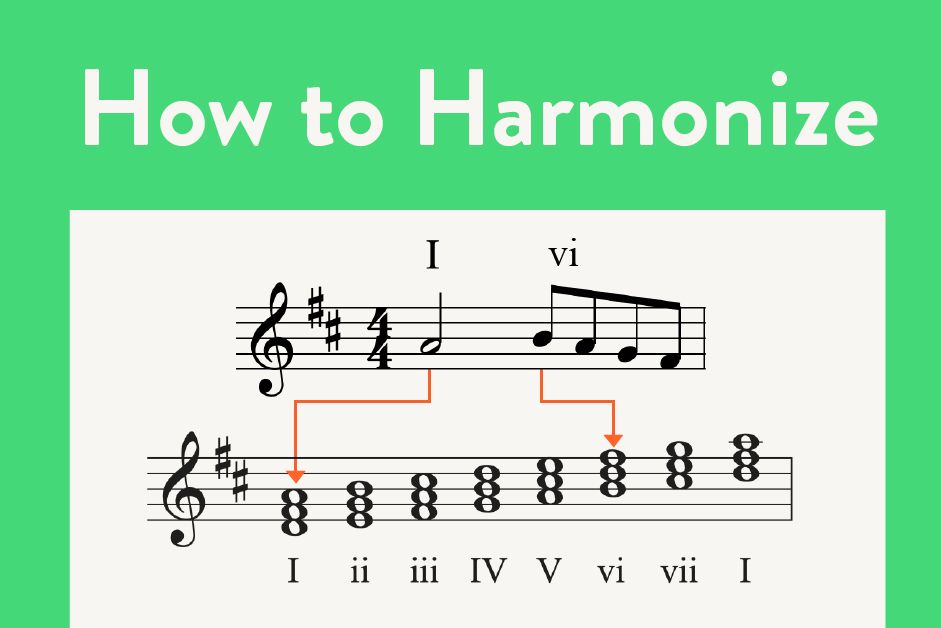
Interested in harmonization? Learn all about how to harmonize in this step-by-step guide
The next time you listen to your favorite songs, try to hear more than just the tune being sung. You’ll notice a rich array of additional tones supporting the melody, adding mood and interest. This is the harmony, and without it, music would consist of only one note at a time, lacking color, tension, or resolution. If a melody is a single line, harmony is what gives that line width and depth. Harmony includes all of the different tones heard at the same time, and in this article we’ll show you some easy steps for adding harmony to any melody.
What is harmonization in music?
Here’s a popular melody you may have sung:

This is the part of the song that gets your attention: the tune that you hum. The notes rise and fall, and different note values–quarter notes, dotted quarter notes, and eighth notes–create the rhythm. Beyond that, however, this melody is only a series of consecutive notes. Its expressiveness is limited by the fact that we’re hearing only one tone at a time. But if we add simultaneous tones to the melody, we get something like this:
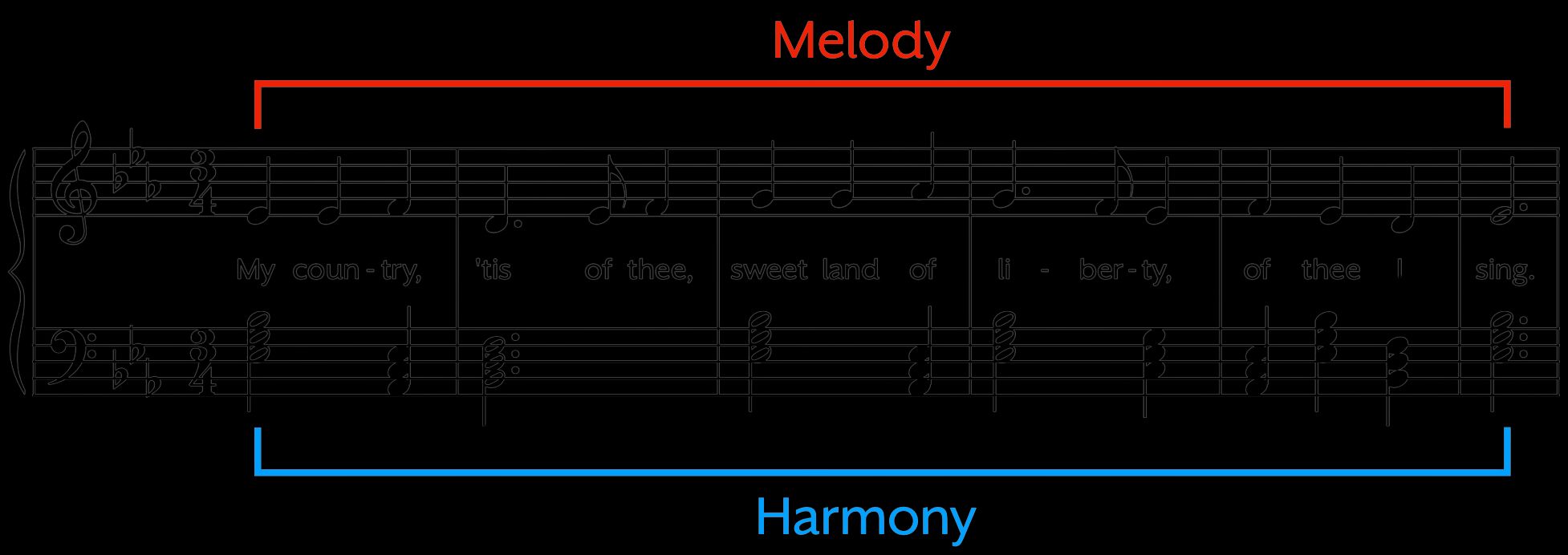
The stacked blocks of notes below the melody are called chords. Now our melody has been harmonized, with several of its notes coinciding with the simultaneous tones of each chord. This gives the tune more richness and tone color, and makes it clear what key the song is in: E-flat major, in this case. The harmony also helps push the music forward, creating tension by moving away from the first chord, which establishes the key signature, then returning to it and resolving that tension.
To learn how to harmonize this entire song, watch these video lessons from unit 13 of the Hoffman Method:
My Country, ‘Tis of Thee Part 1
My Country, ‘Tis of Thee Part 2
How to harmonize for beginners: Step-by-step instructions
Students with limited experience can easily harmonize a melody once they’re familiar with basic chords. The first step is to have a working vocabulary of major and minor triads, which constitute most of the harmony used by composers. For a quick and free resource, download our All Major and Minor Triads Guide! This won’t have every kind of chord there is, but it’s more than enough to get you started with harmonizing your favorite music.
Let’s begin with a melody called Dragon Night, written by none other than Joseph Hoffman! You can also learn how to play this song in Unit 8 of the video lesson library.

You’ll notice that above the melody is a series of chord symbols. This is a special shorthand used for harmonizing melodies, and we call this type of arrangement a lead sheet. A lead sheet features just the melody notes for the right hand, while the chord symbols tell you which chords the left hand should play and when to play them. If we visualize these chords on another music staff below the melody, we can now see how to play both hands together:

Major chords are indicated with just a letter name; D means D major, C is for C major, and so on. If the chord is minor, however, the letter name is followed by a lower case “m.” In the example above you’ll see this in the E minor and B minor chords.
It may take some time to get used to reading lead sheets, and they do require a basic familiarity with chords, but by not having these chords explicitly written out, a lead sheet actually gives the player more flexibility. Beginner students who find the full chords too difficult can simply play the bass, or bottom note, of each chord, like this:

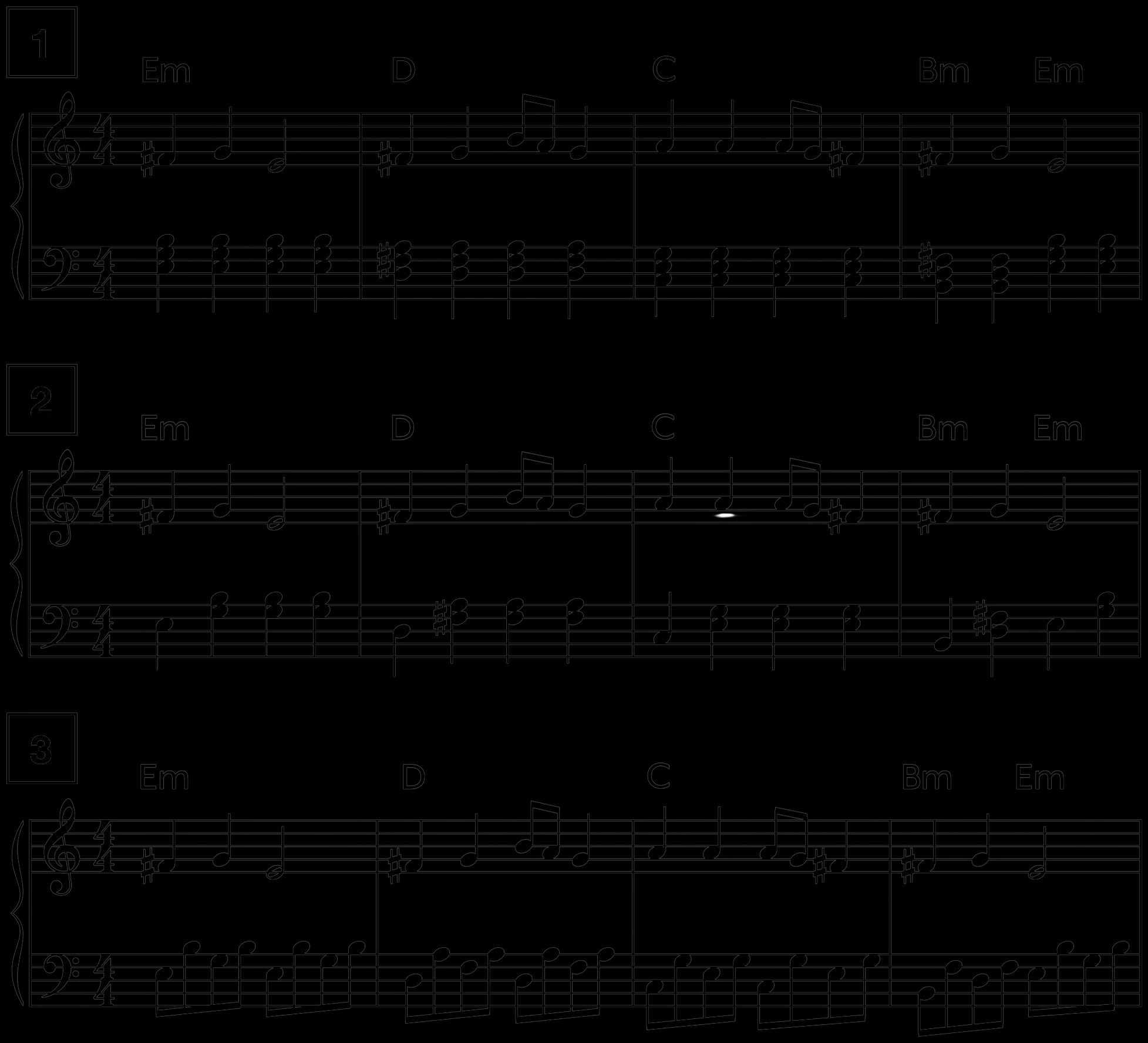
On the other hand, instead of playing and holding down a single chord, students can also play a chord on each beat, adding movement and drive to the song, as in example 1 below. With still more experience, players can break up the chords into various repeating patterns to create a flowing accompaniment, as in examples 2 and 3 below:
How to harmonize for more experienced players
Piano players with at least a few years of experience can learn to harmonize without being told which chords to play. This requires a fluency with scales, diatonic chords, and chord tones. With these skills a player can look at a melody and determine how and which notes to harmonize.
Scales
Let’s start with the C major scale. This scale is a stepwise set of notes filling up the octave from C to the next C, and only uses the white keys on the piano:
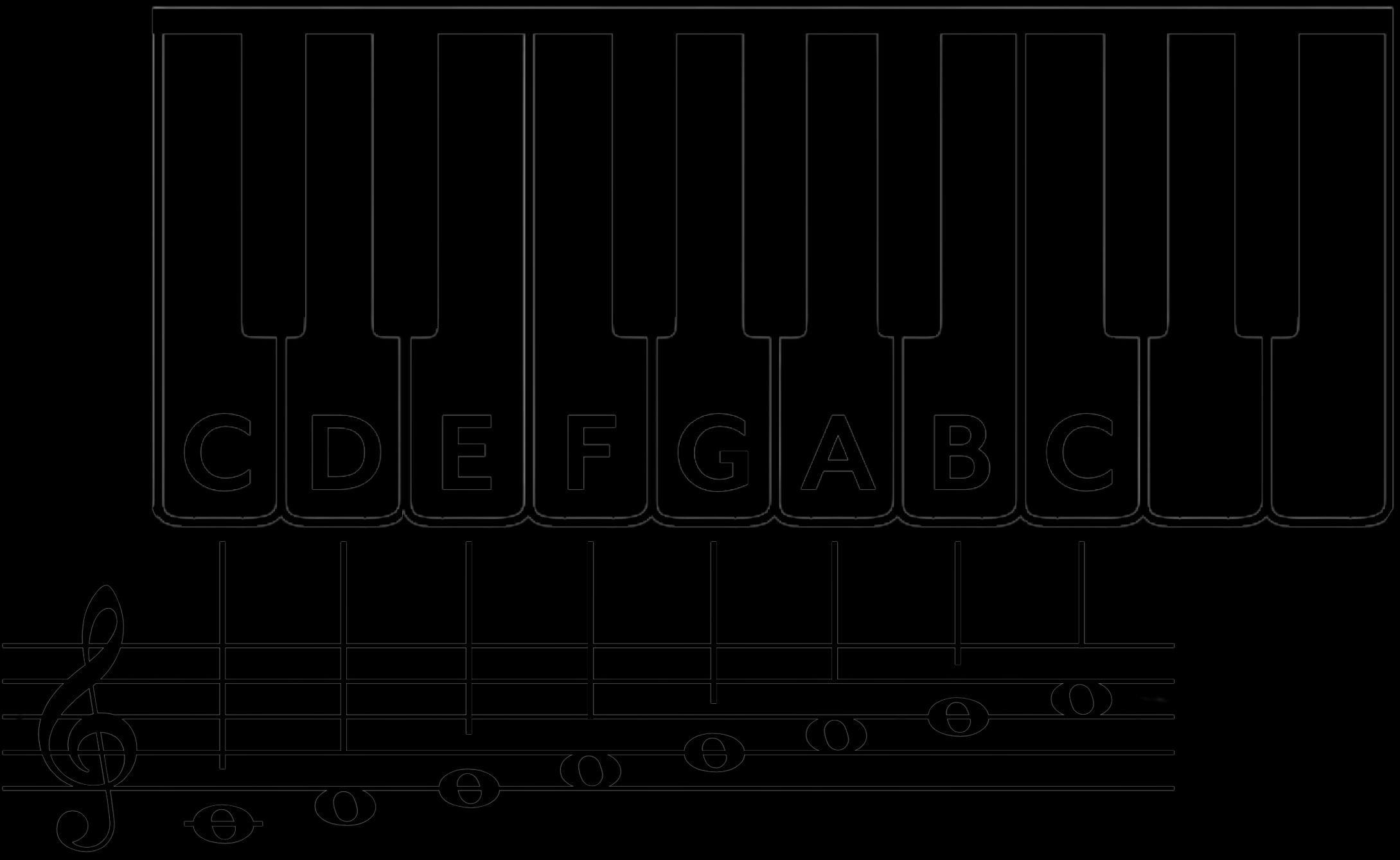
To say that a melody or piece of music is in the key of C major means that it uses the notes of the C major scale. Here’s part of the melody from Angels We Have Heard on High, a popular Christmas hymn. Notice that, while the tune does not start on C, the tonic note, it nevertheless clearly uses the notes of the C major scale:

The blank boxes above the notes are the best places to add chords, the two strongest beats in each measure: beats 1 and 3. These, then, are the notes that will be harmonized.
Diatonic chords
Next, if we stack chords on top of each note in the C major scale, we get the set of diatonic chords in the key of C major. These will be the easiest chords to harmonize the melody with, since they only use the notes of the C major scale:

Chord tones
Finally, look at the melody notes underneath each box. Since these are the notes that will coincide with the chords we add, we generally want to choose chords that contain these notes. This avoids undue dissonance by making each harmonized note a chord tone. Notice below that the first C major chord was chosen because it contains G, the melody note being harmonized. The second chord, F major, also contains the melody note at that instant, this time A. Check the rest of the chords; you’ll find they each contain the melody note they harmonize.
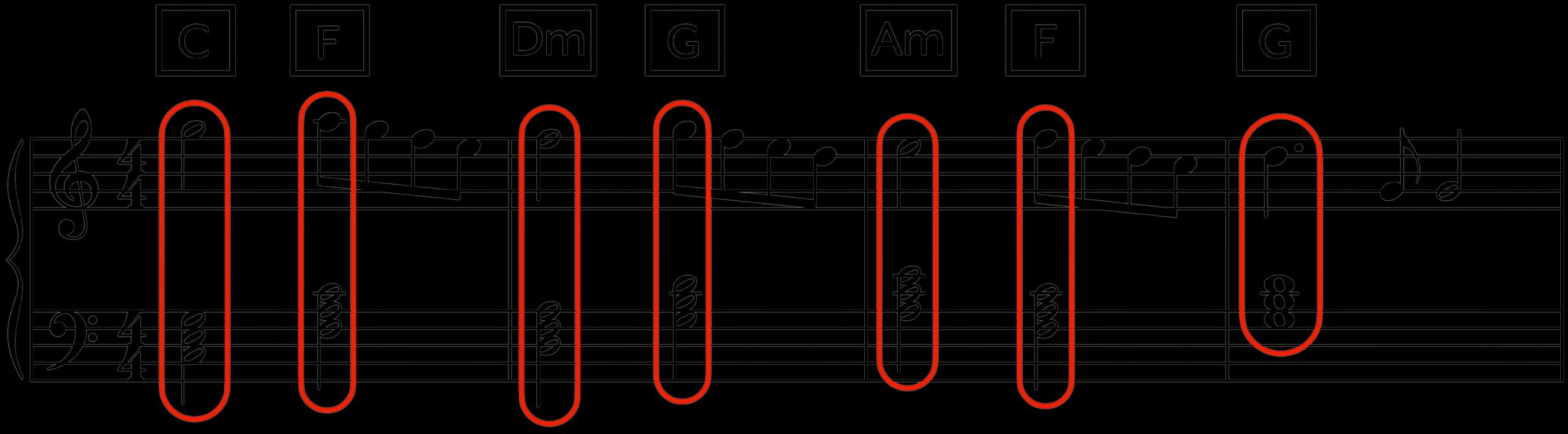
You may also notice that not every melody note gets its own chord. This is typical of most harmonizations, which only match up chords on certain beats. In the first measure of the example above, all four eighth notes on beats 3 and 4 are considered part of the prevailing harmony at that time: an F major chord. This is true even though the melody’s G and E do not appear in the F major chord. These are non-harmonic tones, also called non-chord tones. The G is a passing tone on its way to the next chord tone F. Likewise, the E is a neighbor tone on its way to the chord tone on the next beat. Generally speaking, chord tones will be on the beat, and non-harmonic tones will fall between beats. This way, consonances are emphasized and dissonances are shifted off the beat, where they’re less noticeable. This aesthetic has been a cornerstone of Western music since the early 15th Century. It’s a hierarchy between consonance and dissonance that is as much rhythmic as it is harmonic.
How to harmonize for voice or ensembles
When performing as part of an ensemble, a pianist often does not play the melody, but rather an accompaniment to support a singer or other instrumentalists. This frees the piano player to arrange the harmonies more elaborately, using both hands.
Here is the folk melody All the Pretty Horses from Unit 7 of the Hoffman Method:

While the singer or other musicians take this melody, the pianist can focus entirely on the chords. The most basic layout would have the chords on the right hand and a bass line for the left. In this example, the left hand plays the root notes of each chord–that is, the note each chord is named after. For the A minor chord, the left hand plays A, for the D minor chord, the left hand plays D, and so on, making all the harmony in root position:

Once the piano player has these simple triads and bass notes learned, it’s easy to have fun with different rhythms between the hands, or to break up the chords into arpeggios:

A pianist with several years of experience might create a more elaborate accompaniment by spreading these arpeggios out over a few octaves:

For more instruction on how to harmonize this song, here’s another video from Unit 7 of the Hoffman Method.
More advanced harmonization techniques
Chord inversions
So far, we’ve only seen music examples that feature the chords in root position. This means that the root–the note for which the chord is named–is always on the bottom. If your chord is C major, C will be in the bass (the bottom note). But music can be more sophisticated than this; chords often have their notes shuffled around, so that the root is not in the bass. Chords are then said to be inverted.
Here’s a lead sheet rendition of The Entertainer by Scott Joplin:

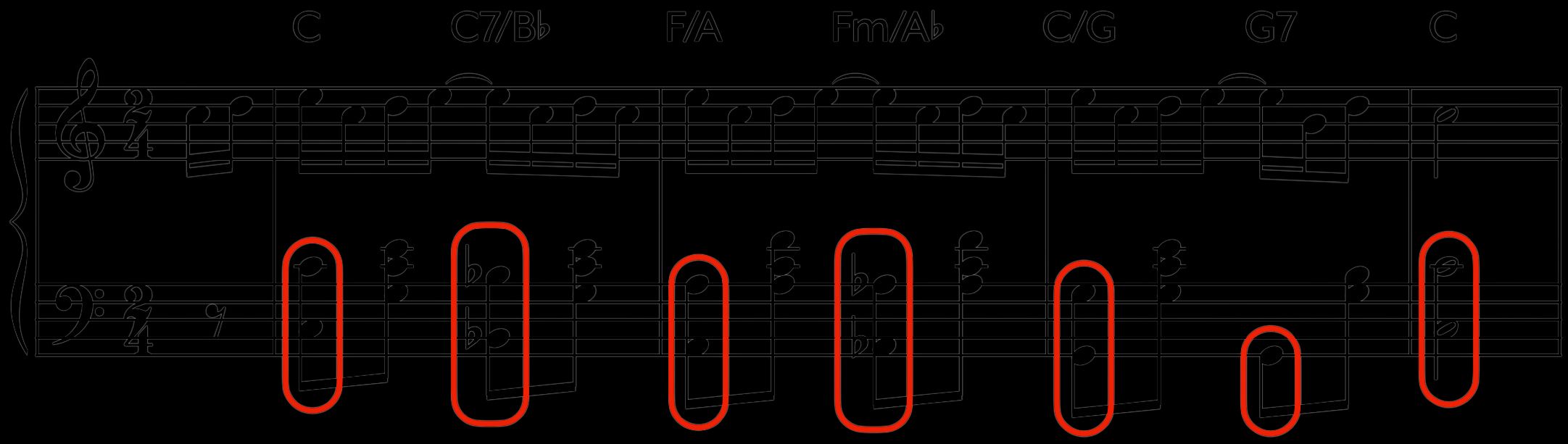
You’ll notice that many of the chord symbols contain a slash, such as C7/Bb. The actual chord name comes before the slash, and the bass note comes after. So this “slash chord” symbol indicates a C dominant seventh chord with B-flat in the bass. In other words, this is a C7 in third inversion. The next chord symbol is F/A, which indicates an F major triad with A in the bass, or F major in first inversion. Only three of the chords are in root position, and their chord symbols only show the chord name. If you simply see G7 with no slash, that means G is in the bass, and the chord is in root position.
Written out, The Entertainer would look like this in its most straightforward form:

When written out this way, it’s easy to see that the lowest note of each chord inversion is marching downward by either a step or a half step each time, C, B flat, A, A flat, G. This creates a strong forward-moving energy and anticipation for the listener, and is one of the reasons a composer might choose to use inversions when writing chords.
Of course, this is a ragtime piece by Scott Joplin, so be prepared for a bit more finesse. His actual left hand part has these chords arranged in a popular “oom-pah” fashion, with the bass notes sounding in octaves on the beat, and the rest of the chord appearing off the beat. This is meant to evoke a brass marching band style:
Try our Triad Inversions reference guide for a free resource on these “flipped-over” chords!
Adding 7ths
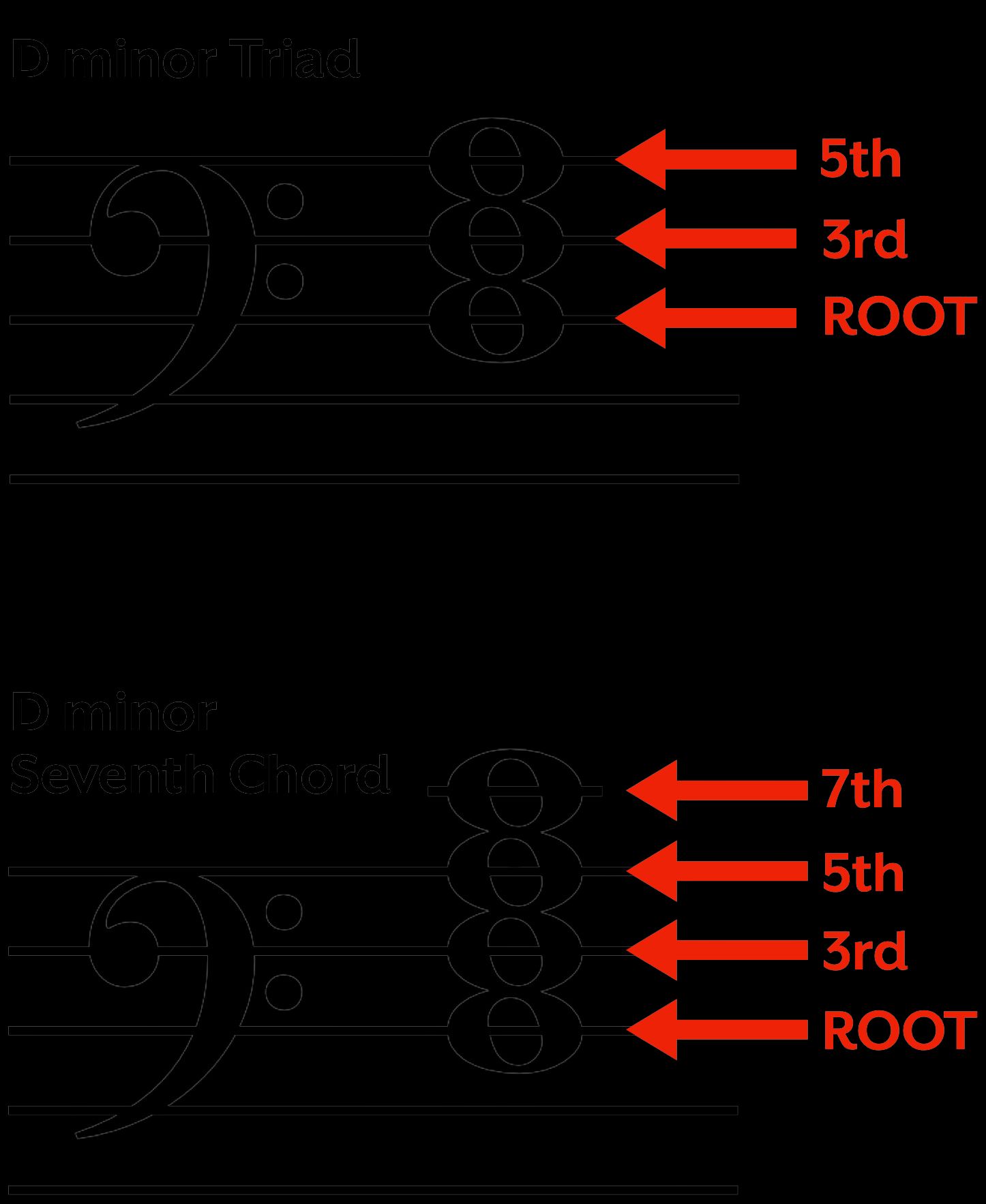
Triads are the simplest chords in tonal music, but these basic harmonies can be spiced up by turning them into seventh chords. A triad consists of just three notes: the root, then a third and a fifth above the root. By stacking one more note on top of the fifth, we get a seventh above the root, and a more dissonant seventh chord:
Seventh chords open musicians up to a greater variety of moods and tone colors, and they can easily jazz up an otherwise more “classical” sounding arrangement. Here is All the Pretty Horses again, this time with its triads turned into seventh chords:

For more help with seventh chords, try our free Ultimate Piano Chord Chart!
Printable resources for harmonization
Try all of the above harmonizing techniques, starting wherever you feel comfortable. You can begin with lead sheet songs that only use triads in root position, and then, when you’re ready, challenge yourself with chord inversions and seventh chords.
Here is a list of printable lead sheet melodies available in the Hoffman Academy store:
When Johnny Comes Marching Home
Some of these will have Roman numerals instead of chord symbols. This is simply a different way to indicate the chords. Here are all the diatonic triads in the key of E-flat major, but this time with both chord symbols and Roman numerals:

The Roman numerals indicate which scale degrees the chords are built on. The I chord is built on the first note in the scale, the ii chord on the second note, and so on. This is true no matter which key you’re in. Also the Roman numerals will be capitalized for major and augmented triads, but lowercase for minor and diminished triads. Finally, you’ll notice that the I, IV, and V chords are major triads, ii, iii, and vi are minor, and vii is diminished. This will also hold true no matter which major scale you build triads on. So, because the Roman numerals are moveable, they help you transpose to any key.
Have fun harmonizing these songs! We’re confident these techniques and resources will enrich your understanding of chords, and help you add the colorful dimension of harmony to your favorite piano music.